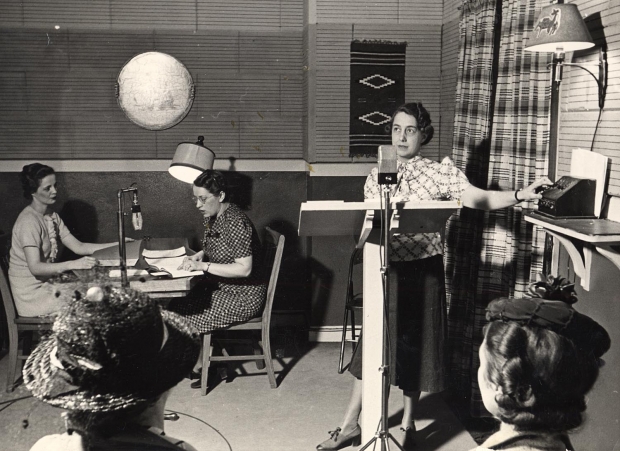
Home Economist Aline Hazard Broadcasting the "Homemaker's Program" on Wisconsin Public Radio.
[Wisconsing Public Radio Archives. Hearing Home, Design and Life Advice from Radio's Early Days. 1938.]
"Town and gown" refers to the relationship between people living in a university town and the faculty and students who work at the school. Tension between the groups occurs when academics are perceived as having little interest in helping members of the public. The Wisconsin Idea encouraged the university community to reach out to people across the state so that the "boundaries of the campus are the boundaries of the state."
The University of Wisconsin-Madison extended its reach into the homes of people across the state when federal funds approved by the 1914 Smith-Lever Act were used to develop a Home Economics Extension Program. Barriers between "town and gown" were broken when Extension Specialists traveled across Wisconsin to share knowledge from the university with citizens of the state. Courses on food safety and home management were taught to groups of women who gathered in various parts of the state. Women shared what they learned with friends and neighbors when they returned to their home communities.
Home Economist Aline Hazard Broadcasting the "Homemaker's Program" on Wisconsin Public Radio.
[Wisconsing Public Radio Archives. Hearing Home, Design and Life Advice from Radio's Early Days. 1938.]
Home Economics Extension Specialists offered courses about food preservation, nutrition, and cost-effective ways to prepare family meals In response to financial challenges facing families during the Great Depression and World War II. The "Homemaker's Program" was broadcast by Wisconsin Public Radio beginning in 1921 and was hosted by Home Economists who covered topics ranging from "Better Breakfasts" and "Making the Winter Wardrobe Do Until Spring" to "How to Eliminate Static in the Home."
The Lab
My Research